
Elektron Outbox 8: how individual outputs changed my workflow
By Matthew Piecora, AKA, EZBOT
Digitakt II and Outbox 8 · September 29, 2026. Individual processing, single-cycle grids, and resampling with the full setup.
I've been waiting for an eternity for a way to get individual tracks out of my Digi-boxes and into the effects I love (or at least would like the opportunity to love). Outbox 8 finally let me put those ideas into practice. After using it with Digitone II, Syntakt, Digitakt II, and M8 Tracker, I’m digging what it does for the whole setup, especially paired with silly ol' Analog Heat +FX.
The biggest change was being able to send a bass or a chord through the Heat without processing the drums along with it. Getting the routing right took some work, and I needed a mixer for the returns (which I did not have). Once that was sorted, I started using effects I already owned a lot more. Now I am addicted and want every pedal I see.
Session 1 · September 9, 2026. First impressions with Digitone II, Octatrack, modular CV, and an M8 profile discovery.
Separate the drums from the synths
I want to drown a melody track in delay or reverb (or both) sometimes. With everything coming out of one stereo pair, that means drowning the drums too. Outbox lets me separate them, which is something I prefer to do with my Octatrack as well.
With Digitone II alone, I split the drums and melodic parts into separate Octatrack inputs. I used the Techno Performance Mixer V2 to perform with those groups. The modular audio returned through Digitone II and joined the melodic side, so I could process the synths together while leaving the drums alone.
Banger.
That separation was immediately fun. I could feed a Digitone melody line into a huge Delay without dragging the rest of the track into it. I could also keep playing the Octatrack’s effects while choosing which sounds went through them.
Sending a track to the Outbox doesn’t automatically remove it from the main mix, so the main-output routing and shared effects need deliberate choices. I also had to remember that the Digitone’s main volume control wasn’t controlling every Outbox path. Which had its perks too.
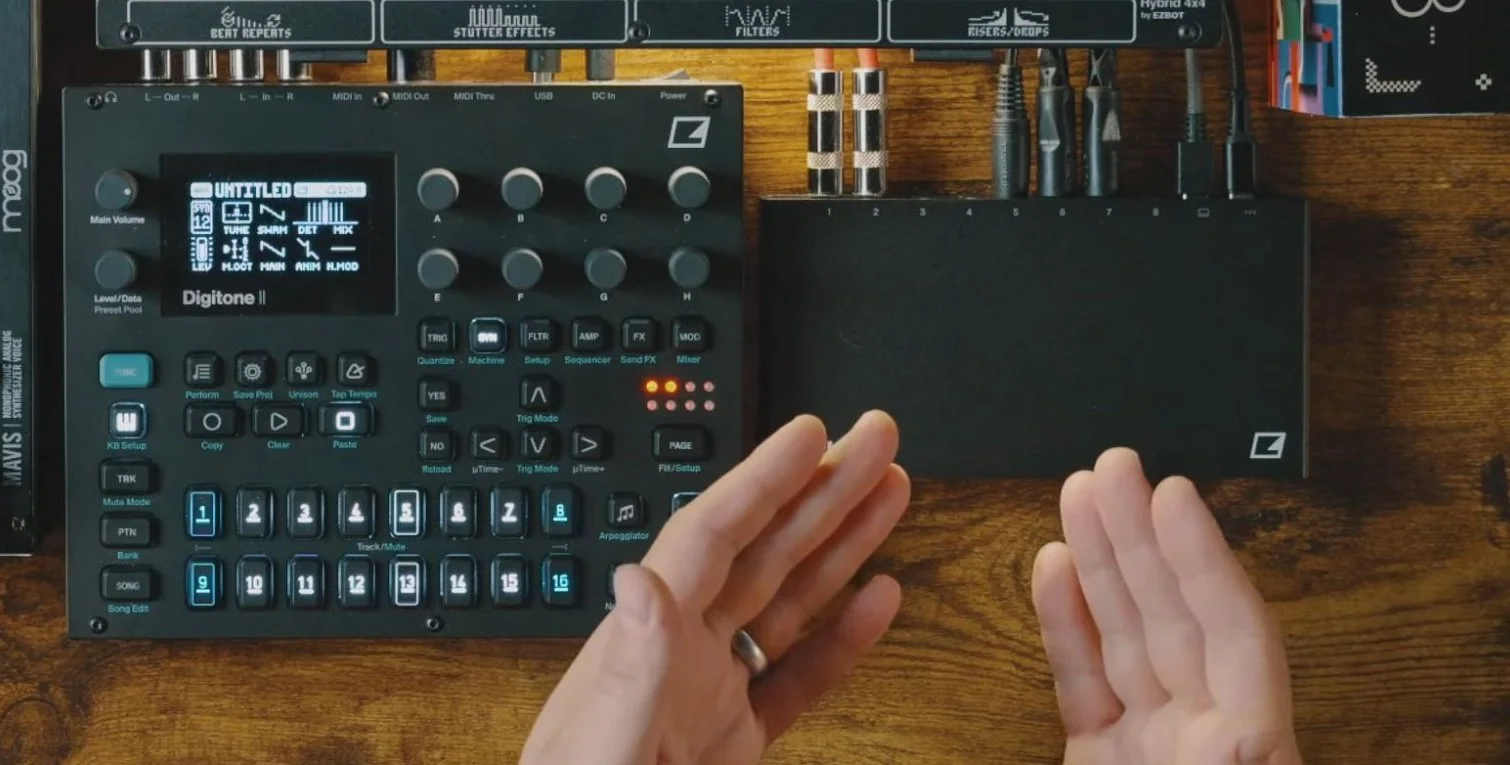
The CV side opens up another connection. I used Digitone II's aftertouch to open the Mavis filter, sequenced changes to a modular delay’s wet mix, and kept the delay clocked. It’s satisfying to keep those gestures alongside the notes instead of treating the modular as a separate performance.
My slower modulation experiments worked better than the fast MIDI LFO-to-CV movement I was trying to get. The LFO through the Outbox 8 feels a bit stepped but it works well enough to have a good time. I’m still interested in exploring that side, but the audio routing is what made the biggest immediate difference to my music.
Session 2 · September 17, 2026. Syntakt routing questions lead to an isolated analog voice through Analog Heat +FX.
Heat became part of the instrument
Syntakt made me rethink what I wanted from the setup. I expected to split it into stereo groups much like the other boxes, but the individual-track panning didn’t behave as I expected in that configuration. Turns out Syntakt sends its individual tracks in mono via Outbox. Trying to make the whole rig fit that plan was frustrating.
Then I sent one analog Dual VCO voice through Heat’s Round Fuzz, compression, and effects. That was the sound that pulled me back into making music. I could push the bass hard while the other parts kept their own space, then give that processed voice its own Octatrack effects treatment.
Typically I use the Analog Heat across the whole mix, where pushing the drive changes everything quite tastefully, you know the classic Analog Heat master chain. On a single voice, I could turn it up much further. Moving the distortion, filter, and effects around in the chain changed that bass without touching the drums.
Firmware note: this Syntakt session predates OS 1.42, which added Main-output routing through Outbox 8. The early routing experience above describes that session. Elektron’s release notes
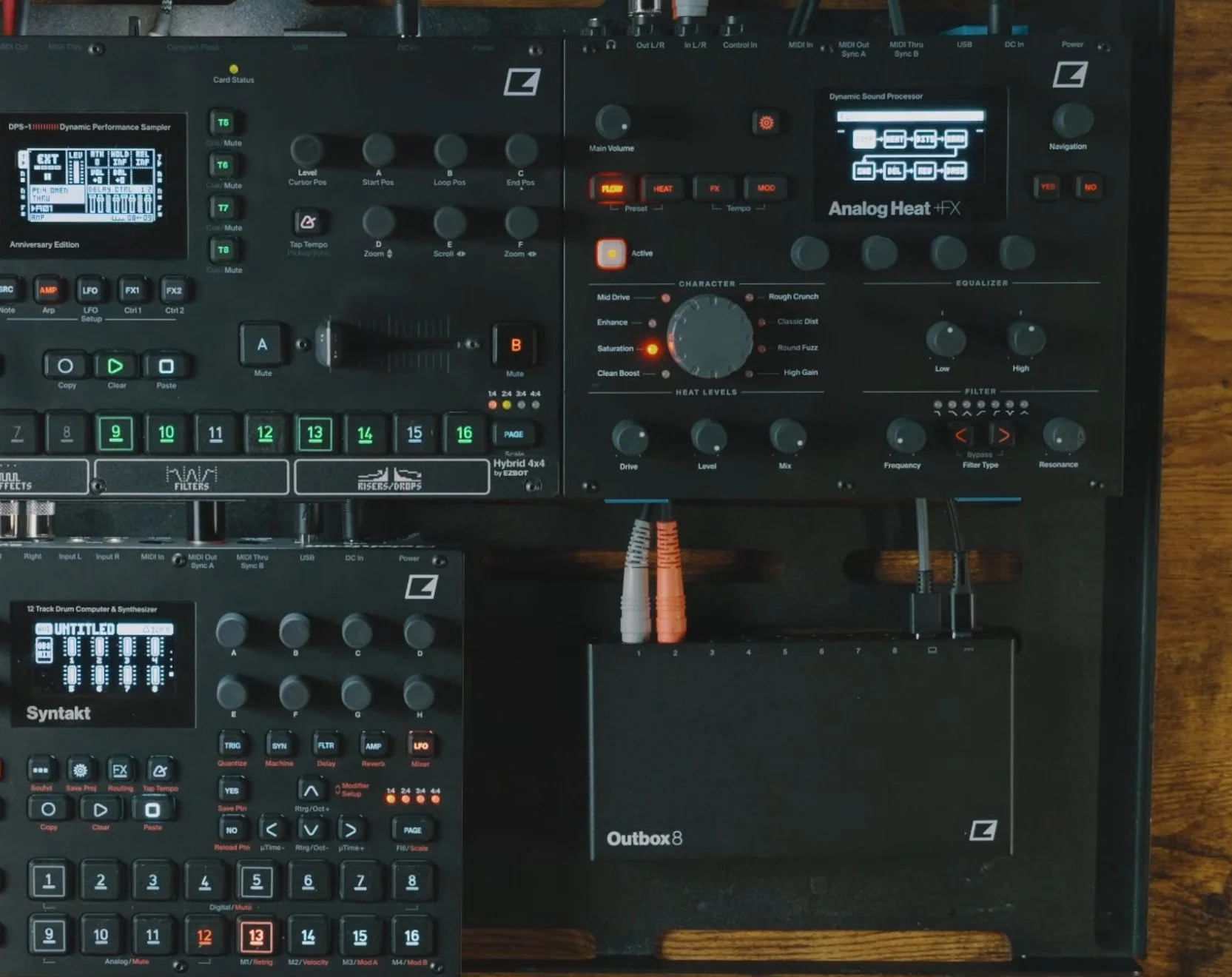
The Digitakt II through the Heat sounded absolutely sick too, and I’m using Analog Heat +FX more than ever. It’s still a substantial box to put next to another Elektron instrument, but the analog drive and filters, effects, presets, and MIDI sync feel much more useful when I can dedicate them to a chosen sound.
It can also be subtle. With dub-techno chord stabs, gentler processing and different delay times on Heat and Digitakt gave the phrase room to breathe. The same setup that made an aggressive bass could make a small chord pattern feel deep and spacious.
Working with Heat’s effects flow · 10:57 · The dub-techno direction · 1:23:10
Making room for the returns
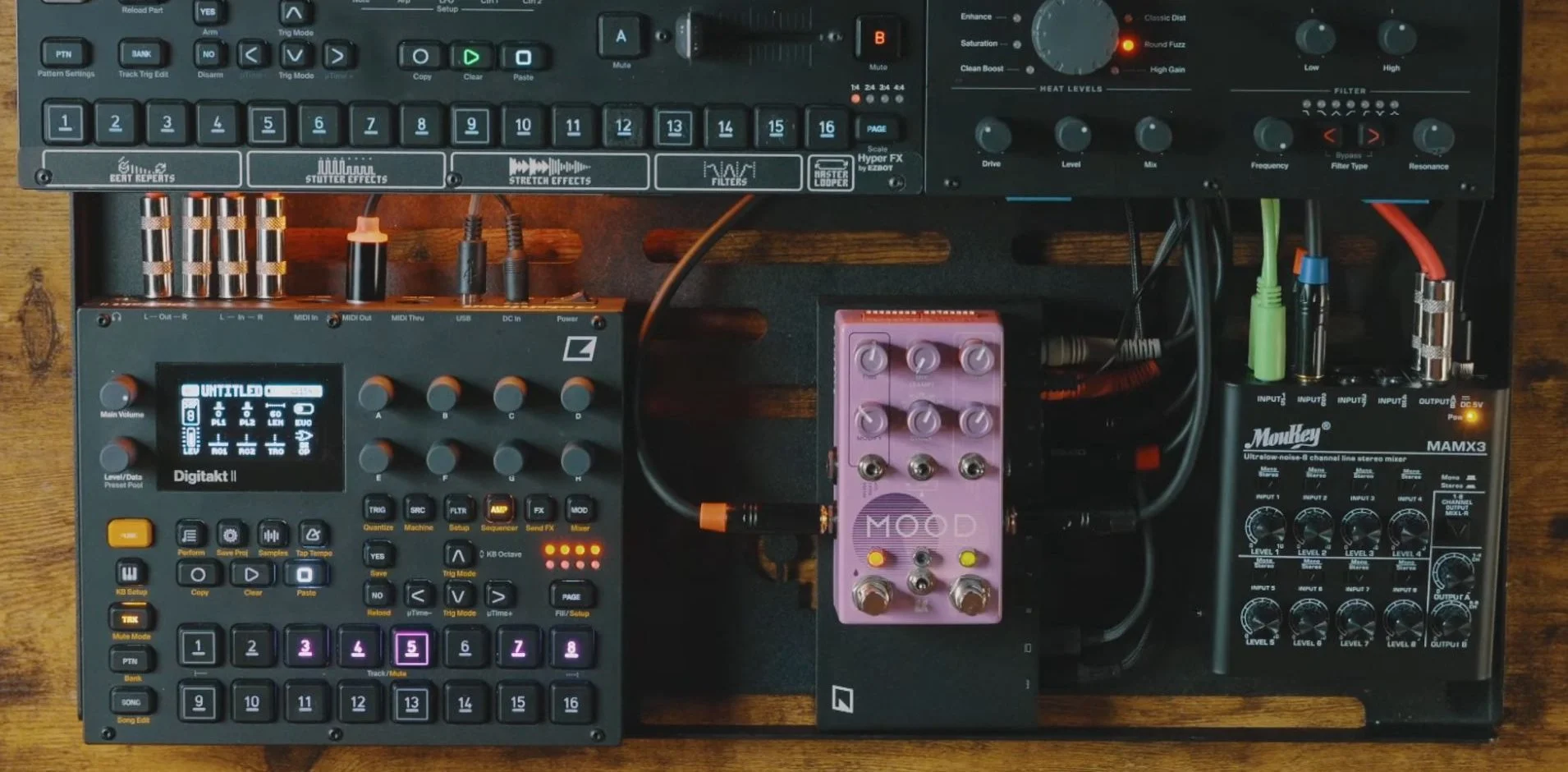
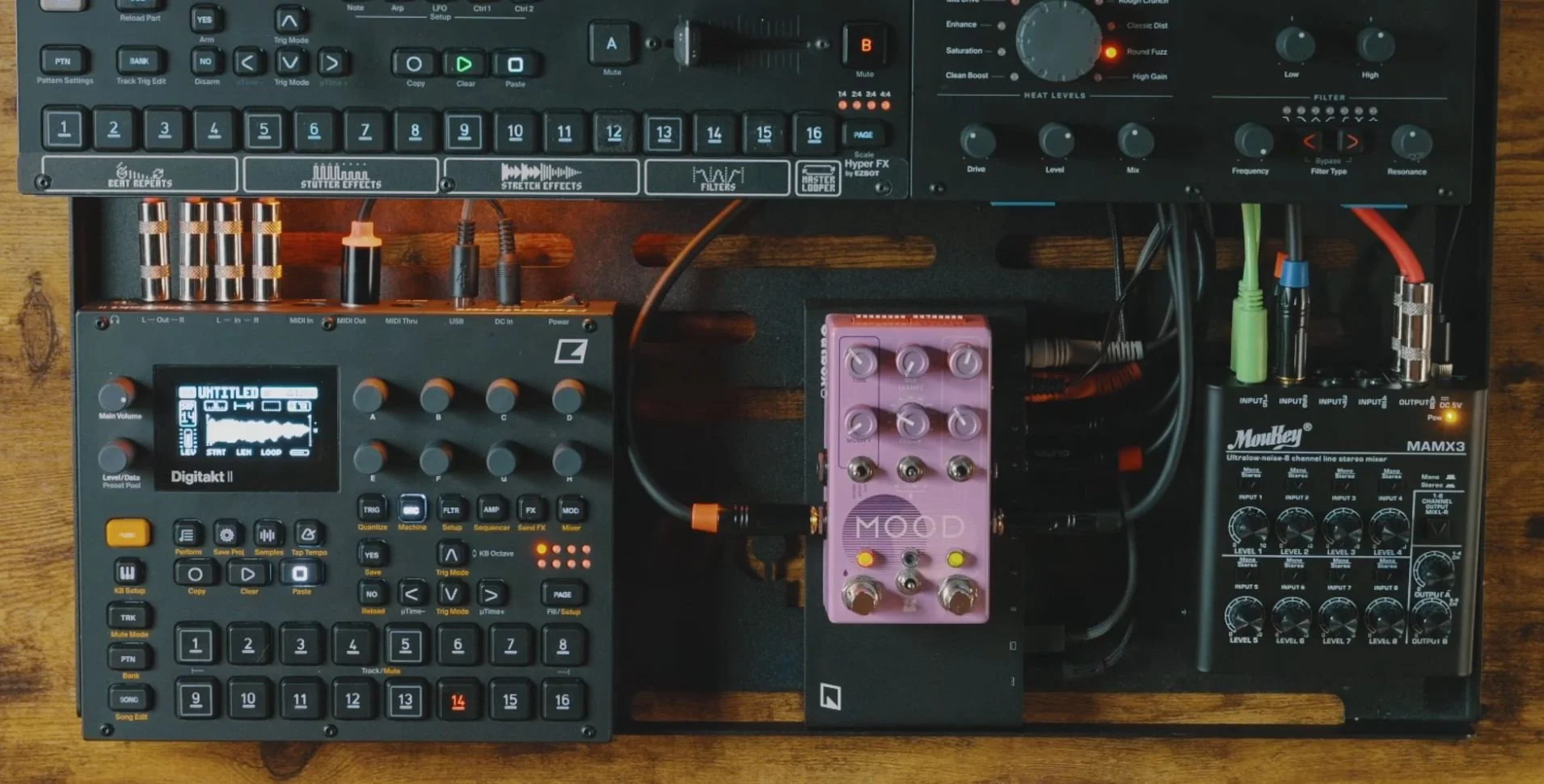
The practical catch is the rest of the wiring. Once I had several processors involved, I needed a small mixer to bring their returns together. A basic compact mixer gave me enough return channels while the Octatrack handled the performance effects. I found one called Moukey 8 Channel Mixer on the interwebs. It's very affordable and does the trick. I recommend it.
I still need shorter cables and a better layout before I’d want this on a live board. The sounds are there. The desk is another story.
How far can I take one sampler?
Digitakt II is by far my favorite sampler, and I wanted to see how much of a setup I could build around it and external processing. I love pairing it with Digitone II, but there’s something appealing about making the sampler cover more of the musical roles.
Its sixteen tracks give me room for alternate groups of parts rather than sixteen sounds playing all the time. External processing complicates that tidy plan a little: a pedal path or a silent compressor-sidechain track also needs a place. I have to account for those tracks when planning the set.
A single-cycle grid into Heat was one of my favorite sounds. In the Digitakt’s Grid machine, I used 64 slices, enabled looping, and selected a numbered slice rather than NOTE. Each evenly spaced piece became a waveform I could play as a pitched sound. Changing the slice changed the oscillator character; analog filtering and distortion took it much further.
The supersaw-style grid got huge very quickly. That was coming from a waveform on the Digitakt and Heat, without adding another synth.
I used my Ultimate Sampler Synthesis Pack, with 450 single-cycle grids and over 500 wavetables. The factory single-cycle waveforms are also well worth trying. You can explore the idea before adding any new sounds.
Keep what the pedal gives you
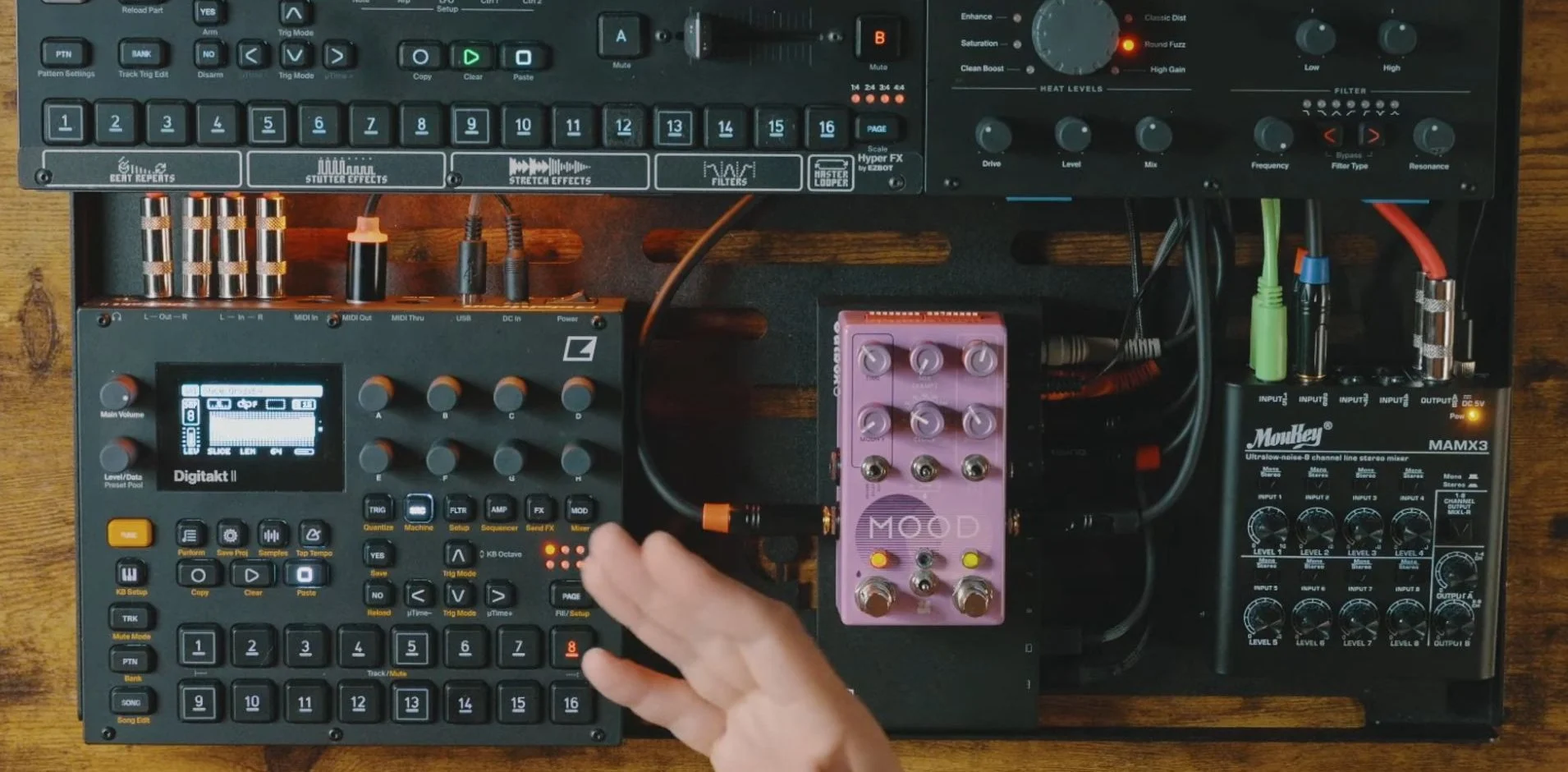
MOOD MKII took a different role. A small noise or vocal sample could come back strange enough to become a new idea. Being able to choose one track for that treatment kept the rest of the arrangement clear. I had a tough time wrangling sounds through the Mood but it still found its way.
When the pedal does something I like, I resample it. Then I can sequence that recording, change its rhythm, and send something else through MOOD without losing the first sound.
My return went through the studio audio interface and needed a routing adjustment on the computer. Outbox supplies the outputs; it doesn’t supply that return path. I turned off input monitoring where I was already hearing the signal, and kept the return from feeding back into itself.
If you want to try this, start with one sound and one processor. A chord stab, short vocal, or factory single-cycle waveform is enough. Send it out to the effect and listen to the return through your mixer. For the insert-style routing I used, remove the track from the main output so the dry signal isn’t automatically layered over it.
Start with modest levels and play one control, such as drive, cutoff, or delay time, until you find something worth keeping. If you have a return into the sampler, record that result without creating a feedback loop or monitoring it twice. Put the recording into a new pattern and try a different rhythm. You don’t need every output connected to hear the benefit.
Why Outbox is staying in the setup
Outbox has earned its place here and I’m especially digging Analog Heat +FX more because of this. It’s become something I reach for while making a sound, instead of mainly processing the finished mix. The Octatrack and Techno Performance Mixer V2 still handle the live effects and transitions, which is perfect for the end of chain.
I was already waiting for a second Outbox when I realized I wasn’t fully using the first one yet. I’ve got more to learn and some wiring to tidy up, but I’m keeping this direction. Hearing what the Heat can do to a single voice was worth working through the routing. I hope these experiments have been helpful, thanks for checking out my work.
Want to support the channel and blogs? Consider using these affiliate links when making a purchase.
Elektron Digitakt II
zZounds · Guitar Center · Perfect Circuit · Sweetwater · Thomann · EU
Elektron Outbox 8
Guitar Center · Sweetwater · Perfect Circuit · Thomann · EU
Elektron Analog Heat +FX
zZounds · Guitar Center · Perfect Circuit · Sweetwater · Thomann · EU
Elektron Syntakt
zZounds · Guitar Center · Perfect Circuit · Sweetwater · Thomann · EU
Elektron Octatrack MKII
zZounds · Guitar Center · Perfect Circuit · Sweetwater · Thomann · EU
Elektron Digitone II
zZounds · Guitar Center · Perfect Circuit · Sweetwater (demo) · Thomann · EU
Cheers,
Matt
If you want the Octatrack performance layer, explore Techno Performance Mixer V2 or Hyper FX. They offer different approaches to live effects. Patreon has years of templates, sound packs, updates, and more to work with.
If you would like help building a routing setup around your own instruments, book a one-on-one lesson. Or join the email list for future sessions, templates, sample packs, and courses.
Help keep the music going.
My YouTube channel and these articles are 100% supported by community donations and Patreon subscriptions. If you found something useful here, a tip helps me keep making and sharing this work. Thanks for being part of it.
Disclosure: Elektron sent me the Outbox 8 used here. These are my own impressions.
Affiliate disclosure: some links in this article are affiliate links. I may earn a commission if you buy through them, at no extra cost to you. These are the exact models discussed here; retailer availability can change.